
Robert J. Martinuzzi, University of Calgary

Title: Boundary Layer – Wake Interactions: A Guide to Inter-Scale Energy Transfer
Abstract
The flow over surface-mounted bluff bodies exposed to thin boundary layers can express a surprisingly wide range of dynamics and topological complexity. This is unlike immersed wakes upon which the extrinsic boundary layer dynamics are imposed. For thin boundary layers, the state, receptivity and relative thickness play an important role in exciting intrinsic shear layer instabilities and synchronizing interactions between large-scale coherent structures. The selective amplification or suppression of coherent motions relies on sub and super-harmonic resonance phenomena enabling energy transfer between scales. It will be shown that, subject to a suitable spatio-temporal decomposition, the mechanisms underlying these nonlinear processes can be captured using interpretable low-dimensional models. The methodology is developed for direct numeric simulation (DNS) and particle image velocimetry (PIV) data bases. The importance of inter-scale energy transfer in determining turbulent energy budgets and unsteady aerodynamic loading is illustrated for high-aspect ratio cantilevered geometries and low-lying structures. The analysis shows that the obstacle cross-section for cantilevered cylinders is an important parameter for thin boundary layers but has negligible influence for wakes in thick boundary layers. From a fundamental perspective, the proposed approach is suitable for isolating triadic interactions responsible for spectral redistribution, thus offering insights for potential flow control strategies.
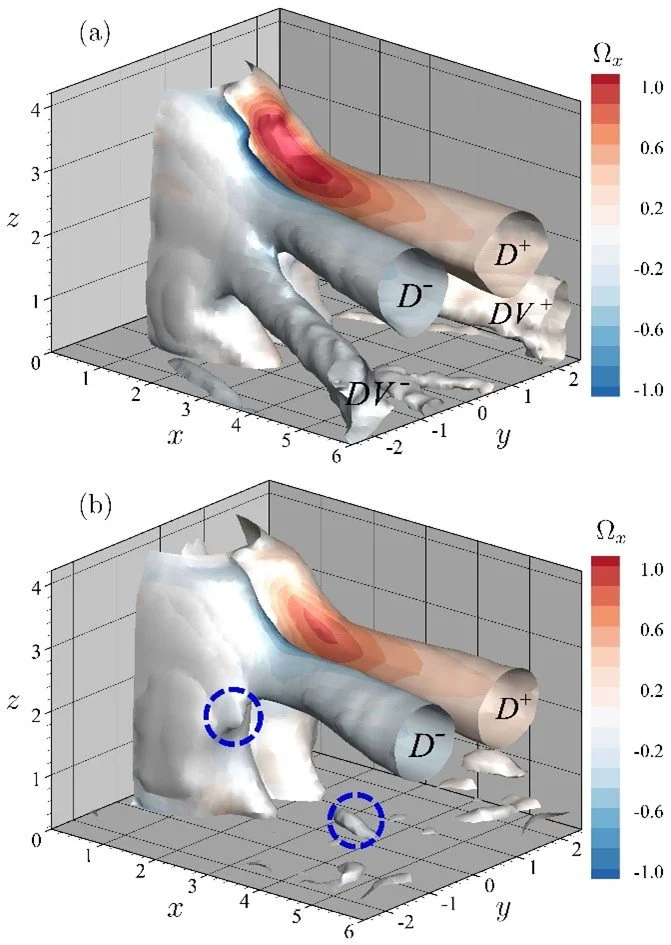
Mean wake structure downstream of a cantilevered square cross-section cylinder of aspect ratio h/d = 4 for (a) laminar and (b) turbulent boundary layer. The boundary layer thickness for both cases is 0.5d. The mean vortex structure is illustrated using iso-surfaces of Q = 0, coloured by contours of streamwise mean vorticity Ω_x .